Radicalism, Anti-racism and Representation; Anti-racism; How to Argue?; New Views; Thomas Spence: The Poor Man’s Revolutionary
“Alastair Bonnett, no doubt the first specialist of antiracism”
Teun A. van Dijk, Antiracist Discourse, 2021
This monograph is about how, why and where radical and anti-racist consciousness develops. Interestingly the group whose political ideas I will be focusing upon—public educationalists—have tended to be neglected in the emergent debate on the ‘politics of location’ (Rich, 1985). Whilst ‘racial’ and gender identities have been widely recognized as legitimate subjects for study, the shared location of many of those taking part in this debate, as public educationalists, has tended to be overlooked. Perhaps it has seemed too self-indulgent a topic to merit attention or a little too close to home for comfort. Whilst the latter assumption may be true the former is certainly misplaced. As we shall see, the critical exploration of public educationalist politics provides a range of insights into the formation of liberal and radical, multicultural and anti-racist, commitments. Routledge, 1993
Reissued in 2022 in Routledge Revivals series. See https://www.routledge.com/Radicalism-Anti-Racism-and-Representation/Bonnett/p/book/9781032365473
“Alastair Bonnett has been one of the most prominent contemporary theorists of antiracism. In his monograph, as well as in a several articles, he offers a systematic sociological, historical and geographical account of antiracism.” Teun A. van Dijk, 2021, Antiracist Discourse, CUP
“Bonnett’s work was among the first to draw attention to the distinct ideologies and idea that helped frame an understanding of antiracism … Bonnett was perhaps the first scholar to provide a rounded account of the ways in which antiracism was not in origin or in practice a singular ideological or political phenomenon. Rather, as he argued forcefully, there were in fact a diverse range of ideas and values that underpinned antiracism and helped to influence the practice both of local and national state institutions and of political and social movements. It is also worth nothing that, although much of the focus in Bonnett’s account was on the British context, he also engaged with key aspects of antiracist ideas and values at a more global level.” John Solomos, 2024, Antiracism: A Critique, Polity.
This introductory text provides students for the first time with an historical and international analysis of the development of anti-racism. Drawing on sources from around the world, the author explains the roots and describes the practice of anti-racism in Western and non-Western societies from Britain and the United States to Malaysia and Peru.
Topics covered include:
* the historical roots of anti-racism
* race issues within organisations
* the practice of anti-racism
* the politics of backlash.
This lively, concise book will be an indispensable resource for all students interested in issues of race, ethnicity and in contemporary society more generally.
How to Argue: A Students Guide: Fourth Edition (London, Sage), 2023
Updated new edition of key student text.
How to Argue will banish fears and confusion felt by students demonstrating their ability to argue. Packed with tried and tested advice, this book will guide them through the techniques of forming an academic argument, from contradictions and tensions, to empirical adequacy, structure and presentation.
READ
Bonnett, A. ‘How to Make a Cogent Argument’, Methodspace, December 2023, https://www.methodspace.com/blog/how-to-make-a-cogent-argument
WATCH
‘How to Argue and be Original’, 15 November 2023, Sage/JS Group public lecture, https://www.youtube.com/watch?v=Ct0VCrXzpcU
“This is an essential read in supporting how to develop an academic argument, idnetifying key areas where most students need assistance and giving practical tips and solutions that enables you to improve developing an academic argument”, – Helen Wilson, University of Derby, ‘Skills for Successful Study’
“‘How to Argue’ is a great book aiming to not only students of higher education but people who are in working environment, especially professionals such as leaders and managers.” -Norwich Business School Executive Book Club
“I have recommended this book over the years to any number of my former students doing either a critical thinking or a university course and all the ones I have met since and did make the purchase made the point of how useful a book this is. It is clearly written and easily applicable to building logical, not just academic, arguments. The latest copy I bought for my daughter. It is still the most useable guide I have come across and I am happy to carry on recommending it.” Amazon review, 4.3 out of the 5, 81 global ratings
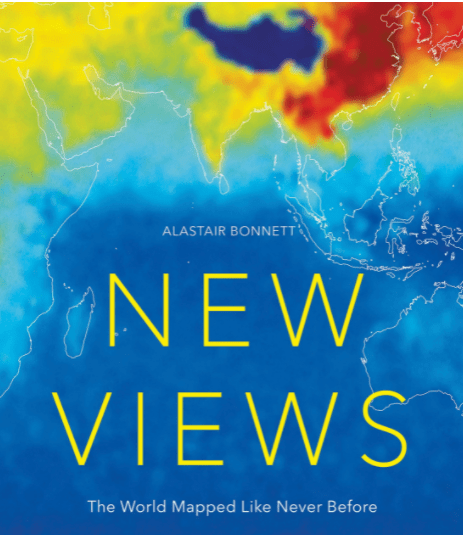
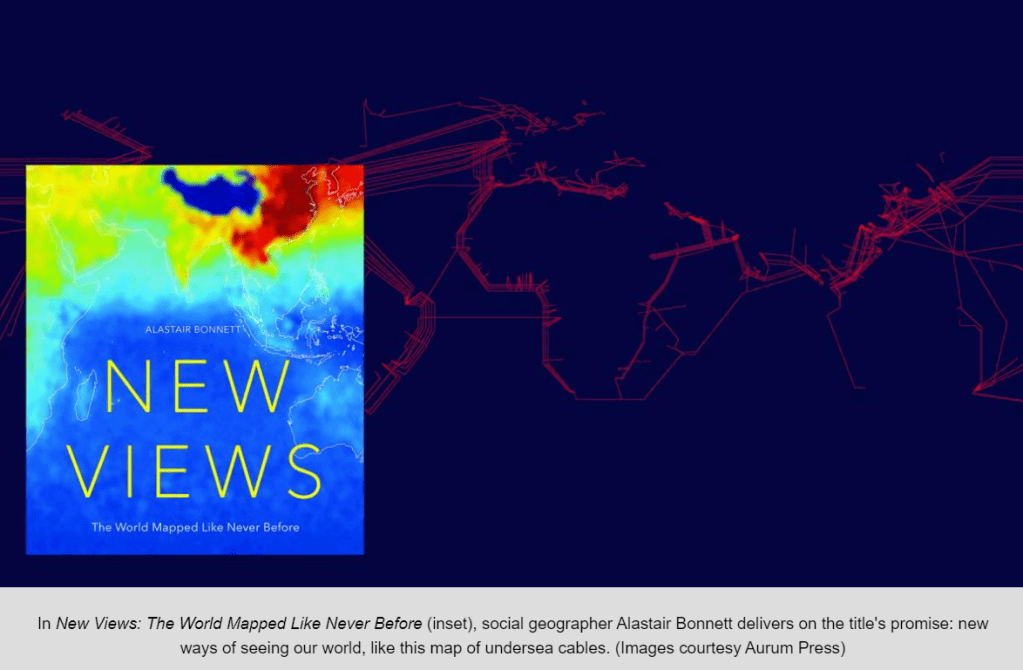
New Views: The World Mapped Like Never Before; also published as An Uncommon Atlas
A unique and beautiful collection of fifty maps in which our physical, political and cultural world is visualised, measured and mapped like never before. From charting energy networks to revealing new and emerging lands, measuring human migration to assessing the planet’s ant populations – and including the phenomena we have little control over such as lightning strikes or asteroid impact – each map asks you to question, wonder and look again at our rapidly changing and often surprising world.
Divided into three thematic sections: Land, Air and Sea; Human and Animal, and Globalisation, New Views offers a fresh and truly global portrait of our intricately fascinating planet.
Press Coverage
‘Dünya’yı Hiç Olmadığı Gibi Görselleştiren 10 Büyüleyici Harita!’, [
10 Fascinating Maps That Visualize The World As Never Before] 2018, Webtekno, https://www.webtekno.com/dunya-yi-hic-olmadigi-gibi-gorsellestiren-10-buyuleyici-harita-h34598.html
Bonnett, A. ‘A map of the world where the sea level has dropped by 100 meters: Taiwan and China are unified’, [海平面下降100公尺的世界地圖:台灣跟中國「統一」了], The News Lens 18th January, 2018, https://www.thenewslens.com/article/87408
‘Voir la Terre d’un nouvel œil’, Le Soir, 9 Decemeber, 2017, https://www.lesoir.be/128611/article/2017-12-09/voir-la-terre-dun-nouvel-oeil
‘Gute karten Öffnen einem die Augen’ Der Standard, 2nd November 2017, http://derstandard.at/2000067007245/Geograf-Gute-Karten-oeffnen-einem-die-Augen
’Huit cartes pour voir la planète autrement’, l‘editiondusoir, 2 November, 2017, https://www.ouest-france.fr/leditiondusoir/2017-11-02/huit-cartes-pour-voir-la-planete-autrement-b8b3429e-d593-4c24-8dbe-62f5480468a5
‘Six new ways to map the world’, Canadian Geographic, 23 October, 2017, https://www.canadiangeographic.ca/article/six-new-ways-map-world
‘Mapping the world with data’, 9th October 2017, Lonely Planet [website] https://www.lonelyplanet.com/articles/mapping-world-data
‘Amazing maps show the world as you’ve never seen it’, The Daily Telegraph, 5th October 2017, http://www.telegraph.co.uk/travel/galleries/amazing-maps-of-the-world-new-views-alastair-bonnett/
Maps of the world as you’ve never seen them before’, Metro 5th October 2017, http://metro.co.uk/2017/10/05/maps-of-the-world-as-youve-never-seen-them-before-6979892/
Fascinating maps reveal the world as you’ve never seen before’, The Daily Express, 5th October 2017, https://www.express.co.uk/pictures/pics/16002/Asteroid-Strikes-The-World-Mapped-Like-Never-Before-photos/294566
‘From venomous animal populations to asteroid strikes: The fascinating maps that visualise the world as never before’, The Daily Mail, 5th October 2017, http://www.dailymail.co.uk/travel/travel_news/article-4948382/20-stunning-maps-reveal-global-activity-minute-detail.html
Thomas Spence
see also http://www.thomas-spence-society.co.uk
Recent Interviews:
‘Against the Grain: A Project by Ruth Ewan’, audio essay exploring the friendship between Thomas Bewick and Thomas Spence, The National Trust, January 2024, https://www.ruthewan.com/against-the-grain/
‘Psychogeography and Thomas Spence, with Alastair Bonnett’, Biographicon, podcast, January 2023, https://biographicon.net/podcast/2-thomas-spence
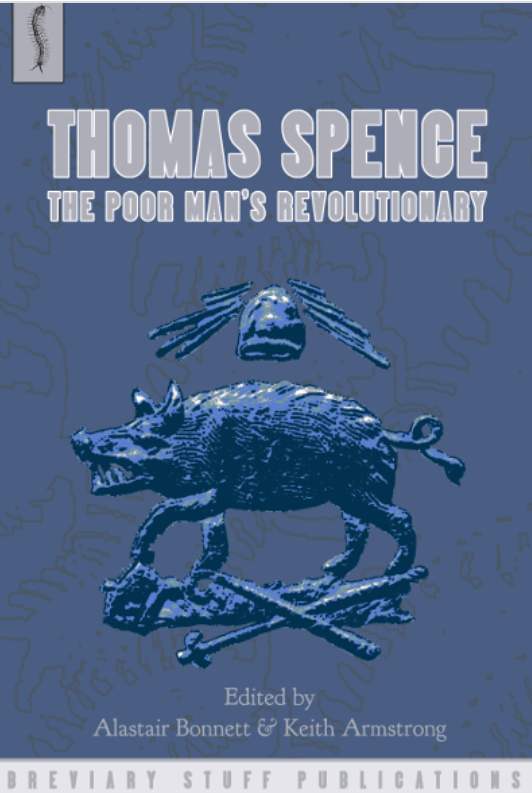
Bonnett, A. ‘The other Rights of Man’, History Today 57, 9, 2007, pp. 42-48
2014 marked the 200th anniversary of the death of an important and original voice in the history of radicalism: Thomas Spence. Today Spence’s name is little known but this in no way reflects his significance. In the first two decades of the nineteenth century it was synonymous with ultra-radical opinion. Thomas Spence was the subject of four contemporary biographical memoirs. Moreover, Spenceanism appears to be unique: it has a good claim to be the only political ideology to have ever been outlawed by the British Parliament. Spence’s scheme for local and democratic ownership of the land found a receptive audience within sections of the labouring poor. In 1817 Thomas Malthus observed that, ‘an idea has lately prevailed among the lower classes of society that the land is the people’s farm, the rent of which ought to be divided equally among them’. Spence’s wish for ‘perfect freedom’ often took him one step further than his peers. He accorded women equal democratic rights but Spence went even further. For what about the rights of children? Spence’s The Rights of Infants no doubt provoked more than a few incredulous smiles when it was published in 1796. Yet cruelty towards children was a topic Spence returned to time and again and it is fitting that today he is cited as one of the world’s first champions of children’s rights. He was an angry man, a revolutionary and an insurrectionist but he was anchored by humanitarian concerns and a wide-ranging, omnivorous, interest in the betterment of his fellows. In this book we hope to go some way in retrieving Spence, of bringing him before a new generation. This book contains works by Spence, including Property in Land Every One’s Right, which has not been in print since it first appeared over 230 years ago, and contributions from Alastair Bonnett, Malcolm Chase, Gregory Claeys, Rachel Hammersley, Jon Mee, John Marangos, Robert W. Rix, Joan C. Beal, Michael T. Davis, and Keith Armstrong.
 Alastair Bonnett